
1099 Filing Dates 2025: 7 Mistakes That Could Cost You Thousands (And How to Fix Them)
- Katie Thomas

- Oct 2, 2025
- 5 min read
Tax season is coming fast, and if you're a small business owner who pays contractors, 1099 forms are probably giving you stress already. Don't worry – you're not alone. Every year, thousands of businesses make costly mistakes with 1099 filing deadlines and requirements that end up costing them serious money in penalties.
The good news? Most of these mistakes are totally preventable once you know what to watch out for. Let's break down the biggest 1099 blunders that could drain your bank account and, more importantly, how to avoid them.
Quick Reference: 2025 1099 Filing Dates
Before we dive into the mistakes, here are the key dates you need to know:
• January 31, 2025: Deadline for giving copies to contractors (all 1099 forms) • January 31, 2025: Deadline for filing 1099-NEC with IRS (both paper and electronic) • February 28, 2025: Deadline for filing other 1099 forms with IRS (paper filing only) • March 31, 2025: Deadline for filing other 1099 forms with IRS (electronic filing)
Special note: 1099-NEC (the one for contractor payments) has stricter deadlines – everything must be done by January 31st, no exceptions.
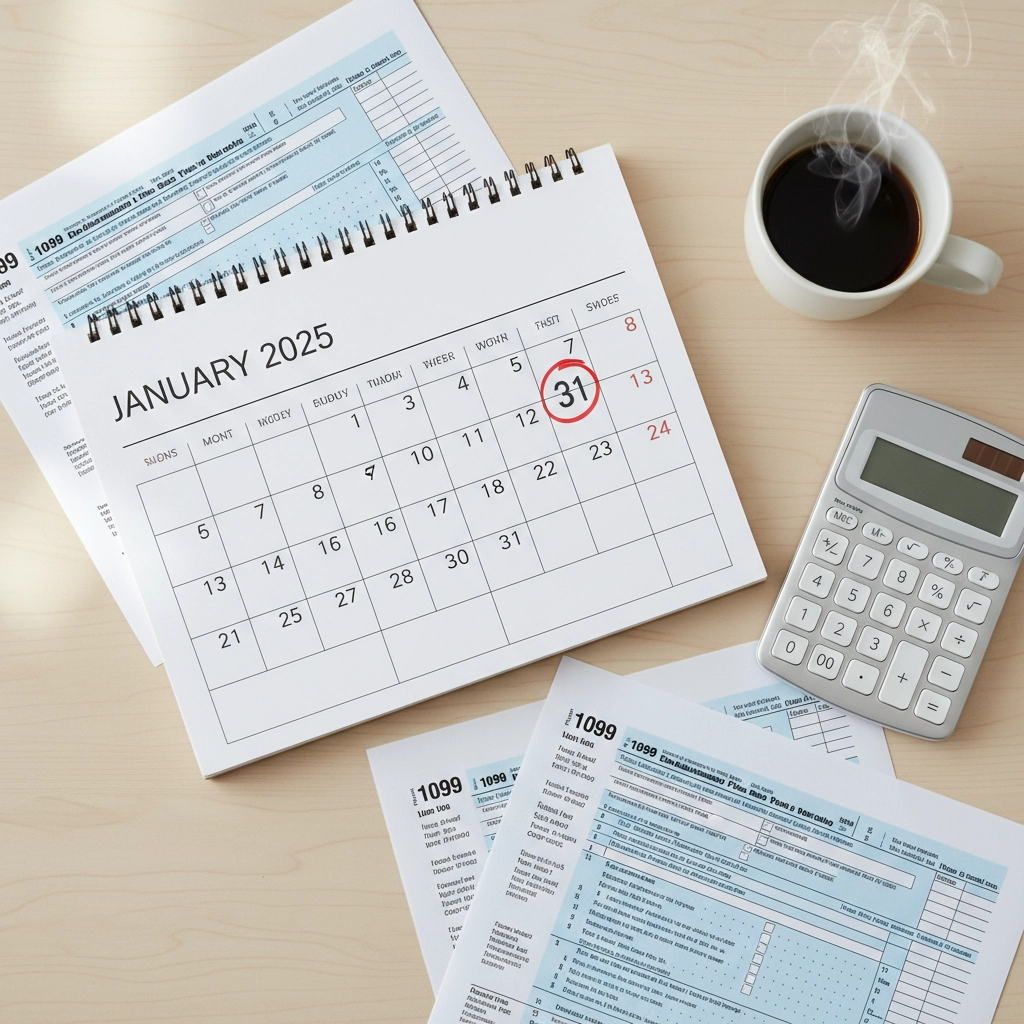
Mistake #1: Missing the January 31st Deadline for 1099-NEC
This is the big one. The 1099-NEC deadline doesn't give you the extra time that other 1099 forms do. Whether you're filing electronically or on paper, both the contractor copies AND the IRS copies must be submitted by January 31, 2025.
Why it's expensive: The IRS charges $60 per form if you're less than 30 days late, $130 per form if you're 31 days to August 1st late, and $330 per form if you're later than that. For a business with 20 contractors, being just one month late costs you $2,600 in penalties alone.
The fix: Mark January 31st on your calendar right now. Set multiple reminders starting in early January. If you use contractors regularly, consider switching to electronic filing and start the process in early January – don't wait until the last week.
Mistake #2: Not Collecting Updated W-9 Forms
Here's a scenario that happens all the time: You've been working with the same contractor for two years. Their business name changed, they got married and changed their last name, or they switched from sole proprietor to LLC. You file their 1099 with the old information, and boom – IRS penalties because the information doesn't match their records.
Why it matters: When contractor information doesn't match IRS records, your 1099 gets rejected or flagged, leading to penalty notices and administrative headaches.
The fix: • Request new W-9 forms from ALL contractors at the start of each year • Don't assume information is still current from last year • Keep a simple checklist: name, address, business structure, and TIN (Tax ID Number) • If a contractor won't provide a W-9, you're required to do backup withholding at 24%
Mistake #3: Using the Wrong 1099 Form
Not all contractor payments get reported on the same form. Most small businesses need 1099-NEC for contractor payments, but there are other situations that require different forms like 1099-MISC for rent or 1099-K for payment processor transactions.
The confusion: Many business owners automatically use 1099-MISC for everything, but contractor payments specifically need to go on 1099-NEC since 2020.
The fix: • Use 1099-NEC for contractor/freelancer payments • Use 1099-MISC for rent, prizes, or other miscellaneous income • If you're unsure, check the IRS instructions or ask your bookkeeper
Mistake #4: Forgetting About Backup Withholding
When contractors don't provide a valid Tax ID Number (TIN) or the IRS notifies you that their TIN is incorrect, you're required to withhold 24% of their payments for backup withholding. Many business owners either don't know about this rule or forget to apply it.
The cost: If you don't do backup withholding when required, you become liable for the taxes that should have been withheld. For a $10,000 contractor payment, that's $2,400 you could owe.
The fix: • Always get a completed W-9 before making payments • If a contractor refuses to provide their TIN, start backup withholding immediately • Keep records of all backup withholding – you'll need to report it

Mistake #5: Filing Paper When You Should File Electronically
If you filed 250 or more information returns in the previous year, you're required to file electronically. But here's the tricky part – "information returns" includes all your 1099s, W-2s, and other forms combined.
Why this catches people: A growing business might hit 250 forms without realizing it, especially when you count W-2s for employees plus 1099s for contractors.
The fix: • Count all your information returns from 2024 (W-2s, 1099s, etc.) • If you hit 250 or more, you must file electronically in 2025 • Register for electronic filing early – the process can take several weeks • Electronic filing also gives you later deadlines for most forms (March 31 instead of February 28)
Mistake #6: Not Filing Corrected Forms
Discovered an error after filing? Maybe you put the wrong payment amount, misspelled a contractor's name, or used an old address. Some business owners figure "it's close enough" or plan to fix it next year. Big mistake.
Why it matters: The IRS wants accurate information. Leaving errors uncorrected can lead to penalties and creates problems for your contractors when they file their tax returns.
The fix: • File corrected forms as soon as you discover errors • Use Copy A marked with an "X" for corrections • Send corrected copies to both the IRS and the contractor • Keep detailed records of what you corrected and when
Mistake #7: Poor Record Keeping
This might not seem like a "filing" mistake, but it creates problems that cost money. Not keeping good records of contractor payments, backup withholding, or filing confirmations makes it hard to prove compliance if the IRS comes asking questions.
The hidden costs: Without proper records, you might: • Pay contractors twice because you can't track what was already paid • Miss contractors who should get 1099s • Be unable to prove you filed correctly if questioned by the IRS • Spend hours (and money) reconstructing information
The fix: • Keep all contractor agreements and W-9 forms • Track payments throughout the year, not just at filing time • Save confirmation receipts for electronic filings • Consider using accounting software that tracks 1099 information automatically

The Real Cost of Getting It Wrong
Let's put this in perspective. A small business with 15 contractors who misses the January 31st deadline by just one month faces $900 in penalties ($60 × 15). Miss it by two months? That's $1,950. Wait until after August 1st? Now you're looking at $4,950 in penalties for something that should have cost you nothing but time.
And these penalties add up fast. The IRS has annual maximums, but they're high – up to $1.3 million for small businesses with intentional disregard of the rules.
Your Action Plan for 2025
Here's what to do right now to avoid these expensive mistakes:
This week: Count your 2024 information returns to see if you need to file electronically
Early January: Request new W-9 forms from all contractors
January 15th: Start preparing your 1099s – don't wait until the last minute
January 25th: Final review and submit everything
Throughout the year: Keep better records and track contractor payments as they happen
When to Get Help
If you're feeling overwhelmed by 1099 requirements, you're not alone. Many small business owners find that the time and stress saved by having a professional handle their 1099 filing is worth the investment, especially when you consider the cost of mistakes.
The key is recognizing when your business has grown beyond what you can comfortably handle on your own. If you're spending more time worrying about tax compliance than growing your business, it might be time to get some help.
Remember, these deadlines don't negotiate, and the IRS doesn't give points for good intentions. But with the right preparation and knowledge, you can handle 1099 season like a pro and keep those hard-earned dollars in your business where they belong.


Comments